

Sand in Your Steel Casting? Here's How We Actually Keep It Out
Let's be honest — sand inclusions are the sneaky ones. A crack you can see. But a pocket of sand buried inside a casting? You don't find out until it's installed, and by then it's scrap, rework, and a phone call you'd rather not make.
So how do you stop it before it happens? At Xin Tengfei, we've been fighting this for thirty years, and it comes down to a few habits we've drilled into every shift.
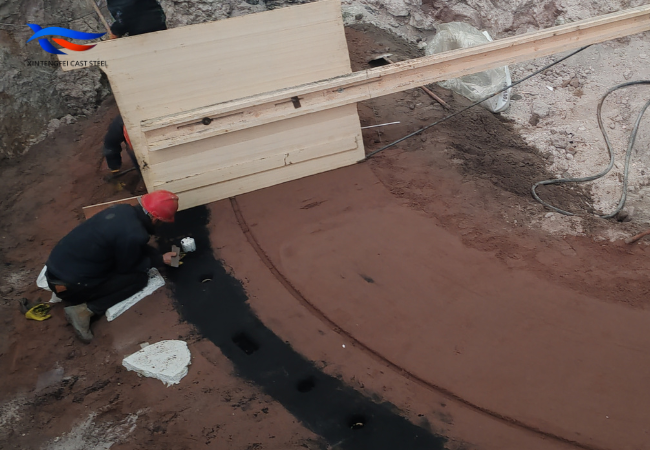
Start with the sand itself
Most people blame the pour when a part comes out sandy. Nine times out of ten, the problem started hours earlier, at the sand mix.
We're picky about base sand — low thermal expansion, decent conductivity, well-graded so it doesn't crack and shed when the heat hits it. The binder ratio matters just as much; get it wrong and you end up with spots that are rock-hard and spots that crumble in your hand.
And moisture. This one catches people every time. We dry molds and cores until residual moisture stays under 1%. Go over that and the high-temperature steam literally blows the mold apart from the inside. We log moisture and strength for every batch — not because I trust my gut, but because a number on paper beats a guess.
The gating system is where you win or lose
Here's the thing nobody tells you: the pour is violent. If your gating design lets molten steel slam straight into the mold wall, you're asking for erosion.
We lay out runners, risers and ingates so the steel spreads out instead of hammering one spot. Gate position and cross-section matter more than most people think. And those dead corners and complex cores where gas gets trapped? We drill vents in there, so the gas escapes instead of swelling the mold surface up into the casting.
What happens on the floor matters more than the drawing
You can have the perfect design and still ruin it with sloppy hands.
Ramming has to be even — same force, every time. We trim sharp edges that like to break off. Before closing the mold, we blow every last grain of loose sand out of the cavity. Handle it gently, because a knocked mold is a defect you'll pay for later. And we pour soon after closing; leave a mold sitting and it picks up moisture, ages, and sheds.
The cheap insurance: mold wash
This one's almost free and people still skip it. A good coat of refractory wash on the mold surface is like a layer of armor — it takes the heat of the steel so the sand underneath doesn't have to. Thirty minutes of work, a huge drop in inclusion rates.
Then watch the pour itself
Temperature and speed. Pour too hot and the sand burns and expands; too cold and you don't fill the mold at all. We keep it in the medium-low range and pour steady — slow to start, then a smooth, continuous fill. No surges, no stopping. And we keep the gap between closing and pouring short.
Do all of that, and the inclusion rate falls off a cliff. Your NDT pass rate climbs right along with it.
Got questions? The four things that cause most inclusions are wet sand, uneven compaction, pouring too hot, and steel hitting the mold wall.
How do you check moisture? Keep the dried mold under 1% and file the test data — traceable, not vibes.
What does sand inclusion actually cost you? Lower strength, worse pressure tightness, scrap and rework — and it drags down your UT/MT pass rate and your yield. All of it preventable.


Henan Xintengfei Steel Casting Co., Ltd.
Henan Xintengfei International Import & Export Trading Co., Ltd.
Henan Gongxing Casting Materials Co., Ltd.
Henan Xintengfei Heavy Industry Technology Co., Ltd.
Henan Zhongshi Xintengfei Shipbuilding Heavy Industry Co., Ltd.
No.1 Qianjin Avenue, Mengzhuang Town, Huixian City, Henan Province, China


