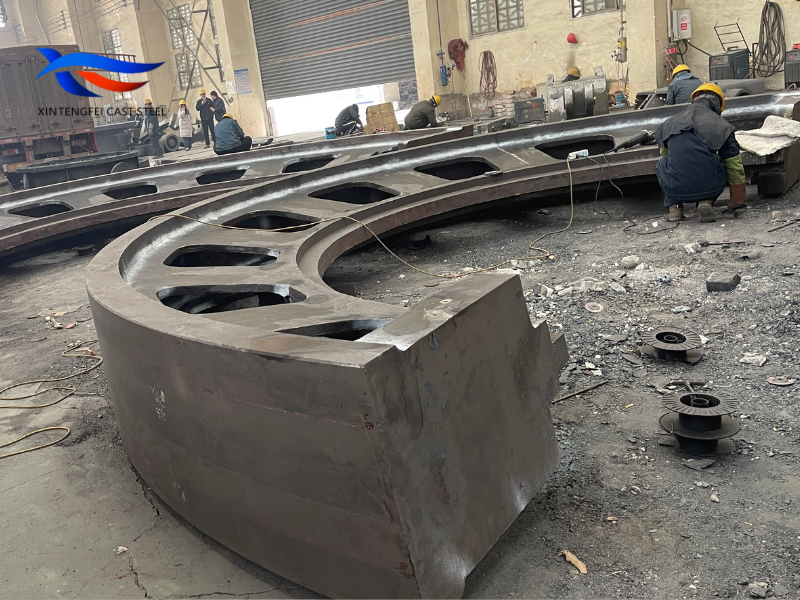
Many cement and metallurgical plant purchasers face the same dilemma when buying rotary kiln girth gears: choosing between one-piece cast gears or two-piece split gears. Though they look similar, wrong selection will bring obvious losses. The procurement cost will rise by 25%–40%, logistics fees will double, and the integral gear may even fail to be installed after delivery. Worse, partial damage to a one-piece gear means full replacement, stopping production for up to half a month and causing daily losses worth hundreds of thousands.
This passage compares the two gear types from four core dimensions: casting manufacturing, logistics transportation, on-site installation, and later maintenance, covering their strengths, weaknesses, and applicable scenarios. Comparison details and scene selection suggestions are included to help purchasers and engineers pick the proper gear within 5 minutes.
Part 1: Four Core Reasons for Two-Piece Split Casting of Large Rotary Kiln Girth Gears
1. Manufacturing: Better Quality & Lower Production Threshold
When casting one-piece annular gears with an outer diameter of 4.5–10 m, uneven wall thickness creates a 10%–14% solidification shrinkage rate, easily triggering defects like shrinkage cavities, porosity, hot cracks, and coarse grains. Even with MAGMA solidification simulation to optimize riser feeding, oversized integral castings still have unstable non-destructive testing pass rates.
Split casting brings obvious advantages:
Higher testing pass rates: Smaller single segments boost molten steel fluidity and internal compactness, raising the one-pass qualification rate of UT ultrasonic testing.
Stable mechanical performance: Smaller workpieces can be evenly heated in heat treatment furnaces, effectively controlling deformation during quenching and high-temperature tempering.
Flexible supply chain: In terms of production capacity, only a small number of leading manufacturers can stably produce quenched & tempered integral gears above 6 m. By contrast, ordinary large foundries can mass-produce split gears with shorter delivery cycles.
2. Logistics Transportation: Remove Oversize Shipping Limits, Cut Export Costs by 40%–60%
One-piece girth gears measure 6–10 m in outer diameter and weigh 40–120 tons each. Domestic road transport needs special oversize approval, and they cannot be loaded into standard shipping containers for export, leading to extremely high logistics costs.
The two-piece split design solves this problem well. After splitting, each segment has a smaller size and weight and can be transported by standard flatbed trucks. Segments fit into standard or open-top shipping containers, slashing logistics expenses by 40%–60% — a core competitive advantage for export orders.
3. On-Site Installation: Fit New & Old Kilns, An Ideal Choice for Kiln Retrofit
After a rotary kiln is fixed in place, supporting rollers and thrust rollers are already assembled. A complete annular gear cannot be sleeved onto the kiln shell from either end.
For split gears, workers hoist the two halves to both sides of the kiln separately, then bolt them together around the shell without disassembling kiln support parts. This is a highly practical scheme for old kiln renovation, while one-piece gears can hardly be installed on existing production lines.
4. Post-Operation Maintenance: Reduce Downtime & Production Losses
If a one-piece gear suffers partial tooth wear or cracks, the whole gear must be replaced, resulting in a 7–15 day production shutdown and huge daily losses.
For two-piece split gears, only the damaged half needs to be replaced, and maintenance can be finished within 2–4 days. Meanwhile, cast steel’s weldability further lowers maintenance costs and downtime losses.
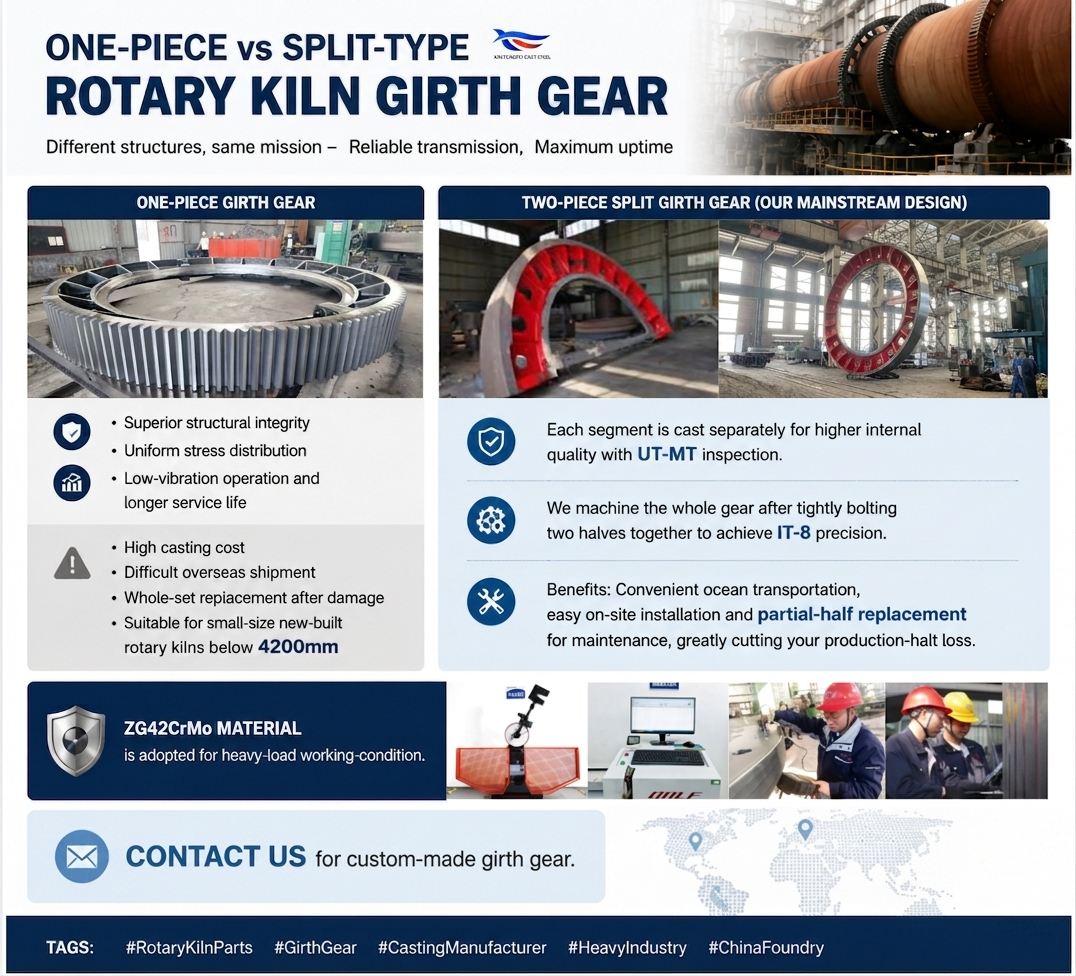
Part 2: Comparison Between One-Piece and Two-Piece Split Cast Girth Gear
Option A: One-Piece Cast Rotary Kiln Girth Gear
Core Strengths:
Integrated structure without splicing gaps, uniform circumferential rigidity, lower operation vibration, and longer tooth root fatigue life.
No splicing bolts, so regular shutdown for bolt retightening is unnecessary, avoiding tooth jumping and impact pitting caused by loose bolts.
Free of on-site assembly errors; precision is only controlled by casting, heat treatment, and gear hobbing processes.
Main Disadvantages:
Purchase cost is 25%–40% higher, and only advanced heavy industry factories have the capacity to produce it.
Oversized annular castings carry high risks of internal defects; the whole gear has to be scrapped once shrinkage cavities or cracks appear.
Strict logistics restrictions make export difficult, and it cannot be used for old kiln retrofits.
Partial damage requires full replacement, leading to long maintenance cycles and heavy production losses.
Applicable Scenarios:
Small and medium-sized new rotary kilns below 4.2 m, projects with spacious yards, convenient transportation, and domestic production lines requiring ultra-stable running performance.
Option B: Two-Piece Split Cast Girth Gear (Industry Mainstream)
Core Strengths:
Lower cost, shorter lead time, and more alternative suppliers. Small split segments achieve far higher UT/MT non-destructive testing pass rates than large one-piece castings.
Convenient transportation and compatibility with standard shipping containers, bringing prominent advantages for export business.
Suitable for both new kiln assembly and old kiln transformation. Only the damaged half needs replacement after local failure, greatly shortening production downtime.
Main Disadvantages:
Product quality heavily relies on processing technology. The two halves must be tightly bolted before integral gear hobbing; separate machining will cause dimensional deviation.
Splicing bolts easily suffer stress relaxation under long-term high temperature and kiln shell deformation, so retightening during shutdown is needed 1–2 years after commissioning.
Splicing surfaces demand ultra-high machining precision; locating pins and high-strength reamer bolts are required to eliminate assembly errors.
Applicable Scenarios:
Large rotary kilns above 4.5 m, overseas export projects, and old kiln retrofits. The vast majority of large rotary kilns worldwide adopt this structure at present.
Part 3: Gear Selection Guide for Different Working Conditions
Condition 1: Kiln diameter below 4200 mm, new production line, convenient domestic transportation
Recommendation: Choose a one-piece cast girth gear. Its integrated structure ensures stable operation, less bolt maintenance, and a longer service life.
Condition 2: Kiln diameter above 4500 mm, overseas export orders, old kiln gear replacement
Recommendation: Two-piece split gear is the preferred choice. After bolting the two halves together, we conduct integral hobbing to reach IT8 precision. Made of ZG42CrMo steel with Grade-II UT inspection, its service life matches one-piece gears, with obvious advantages in transportation and maintenance costs.
Condition 3: Super-large special rotary kilns over 8 m
Recommendation: Four-segment gears are rarely used. Extra splicing joints put extremely strict requirements on machining and assembly precision, so we do not recommend it for conventional projects.
Part 4: Frequently Asked Customer Questions (FAQ)
Q1: Why do most large rotary kiln manufacturers adopt two-piece split girth gears?
A: One-piece gears have frequent casting defects and strict transportation limits. Split gears balance manufacturing, logistics, installation, and maintenance needs, and are highly suitable for export projects, making them the mainstream solution in the market.
Q2: Will split gears produce strong vibration or tooth breakage at the splicing position?
A: Regular manufacturers will hob the whole gear after bolting two halves tightly to guarantee IT8 tooth pitch precision, equipped with locating pins and high-strength reamer bolts. If you retighten bolts on schedule, no impact or tooth breakage will occur during normal operation.
Q3: Is there a big gap in service life between one-piece and split girth gears?
A: Qualified two-piece split gears (ZG42CrMo material + integral hobbing + Grade-II non-destructive testing) have a service life close to one-piece gears. Early tooth wear only happens on inferior split gears processed by separate hobbing.
Q4: Which gear type is more suitable for overseas export projects?
A: Two-piece split gears are preferred. They can be loaded into standard shipping containers to avoid expensive oversize transport fees. Clients only need to replace the damaged half on site instead of buying a full gear, which greatly cuts long-term operation and maintenance costs.
Part 5: General Selection Suggestions & Service Offer
Small new kilns with ultra-stable operation requirements: One-piece girth gear
Large kilns, export projects, old kiln retrofits: Two-piece split girth gear (High cost-performance)
Contact Us for Professional Solutions:
Our factory customizes ZG42CrMo rotary kiln girth gears in one-piece or two-piece split styles. All products come with complete UT & MT non-destructive testing reports and IT8 machining precision. Please send us your kiln diameter, production capacity, and export demands, and we will provide a professional gear selection scheme.