

Sourcing Large Gear Castings for Heavy Machinery: Don't Just Compare the Price
I've been buying castings for years. The worst feeling isn't a hard drawing. It's a supplier that *looks* right on paper, then lets you down.
A buddy told me about a ball mill girth gear he bought last year. Went with the cheapest quote. Part shows up, NDT goes through it, and the rim is full of shrinkage. UT? Just noise. Unusable. He reordered. Three more months gone. The mill sat idle the whole time.
Was the few thousand he saved worth three months of downtime? Probably not.
Big gears, girth gears, support rollers, hollow shafts — you don't roll the dice on these. So here's the short list. Five questions. Ask them before you send the PO.
1. "Have you actually cast a part like mine?"
Don't open with price. Open with this.
A small casting breaks, you replace it. A girth gear breaks, you're tearing the line down, losing money every hour. So ask: have you done rotary kiln parts, ball mills, crushers, slag pots? Ask for actual orders — project name, weight, material grade. "We've done a lot of these" tells you nothing.
Foundries that have done this before know where the trouble hides. They know where shrinkage likes to pop up. They know how much machining allowance to leave. They've been burned before. A shop that's never touched this part isn't doomed, but honestly, you're probably the one paying for their trial run.
2. "Meets spec — or can you show me the furnace spectro?"
"Meets spec" is the four cheapest words in this business.
ZG42CrMo, ZG35CrMo — same grade on paper, totally different parts depending on the job. Strength, hardness, wear — it all changes. So ask one thing: every heat, do you run a furnaceside spectro? Not one summary cert at the end. Per heat.
Real shops run composition checks three times per heat during melting. Sulfur held at 0.010%, phosphorus at 0.015%. The cheap quotes? That's where they cut corners. Scrap from whoknowswhere. Alloy additions eyeballed. S and P out of spec. Dirty steel. You can't see it at delivery. It shows up six months later when the gear face cracks.
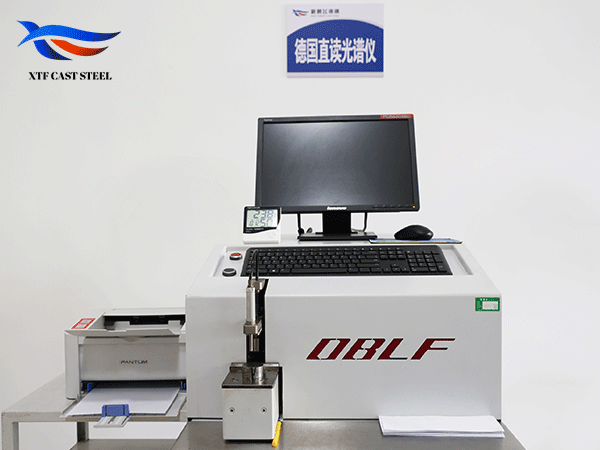
3. "Heat treatment — customized, or one furnace bake for everything?"
Shrinkage, porosity, cracks in a big gear — 9 times out of 10 it's pouring and heat treatment gone wrong.
Ask three things:
CAE simulation before pouring? Mold filling only, or solidification and shrinkage modeled too?
How many tons does your furnace hold?
Can you write a custom curve per material?
If the part doesn't fit in their furnace and it goes out for heat treatment, you've lost control of quality and timing. Real shops normalize at 880–920°C, temper at 600–650°C. Hard face, tough core. That's not something you fake.
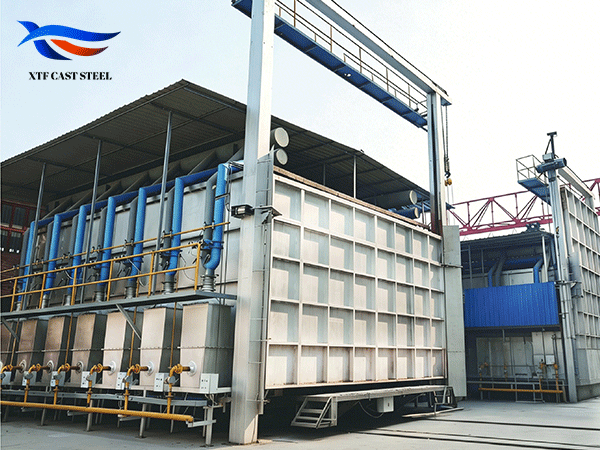
4. "Machining — inhouse, or shipped out?"
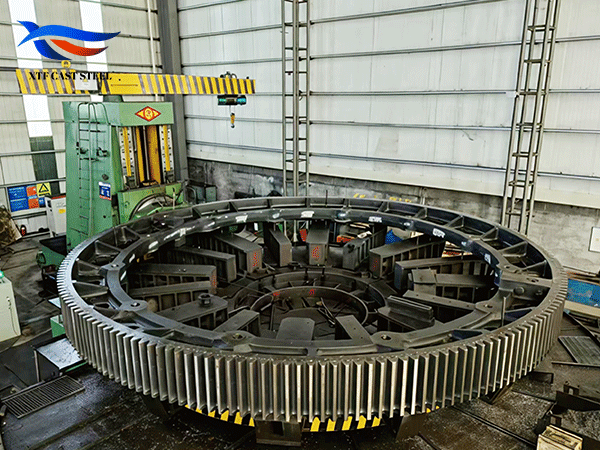
Casting isn't the finish line. A girth gear cares about center distance, tooth alignment, runout. If the shop doesn't have its own CNC vertical lathe, gear hobber, boring mill — everything goes out. Risk goes up fast.
Look for the CNC hobbing machine. Ask max diameter, max load, how allowance is left. Inhouse means one throat to choke. Outsourced means the foundry blames the machine shop and the machine shop blames the foundry when something goes wrong. Big gears also need splithalf match machining and a real turningandmilling sequence to hold tooth spacing. You can't fake that with borrowed equipment.
5. "NDT — UT, or UT plus MT?"
Inspection tells you more about a shop than any sales deck.
Check: spectrometer on site?
UT and MT equipment inhouse?
Dual UT+MT on loadbearing parts?
A lab that does tensile, impact, hardness?
 ISO 9001 is table stakes. But more important than the cert — pull a random batch. Look at the furnace spectro. Look at the heat treatment curve. Look at the UT report. Is there one for every batch? For gears, the tooth zone should hit ASTM A609 Level 1, rim Level 2. "We do NDT" isn't an answer.
Look. Qualifications get you in the door. The workshop floor tells you the truth. Brochures get polished. But the furnace size, the condition of the NDT gear, whether the hobber is an import or some bolttogether kit — that stuff doesn't lie. Get straight answers on these five first. Then talk price.
#GirthGear #RotaryKiln #BallMill #SteelCasting #Foundry #HeavyMachinery


Henan Xintengfei Steel Casting Co., Ltd.
Henan Xintengfei International Import & Export Trading Co., Ltd.
Henan Gongxing Casting Materials Co., Ltd.
Henan Xintengfei Heavy Industry Technology Co., Ltd.
Henan Zhongshi Xintengfei Shipbuilding Heavy Industry Co., Ltd.
No.1 Qianjin Avenue, Mengzhuang Town, Huixian City, Henan Province, China


