

How to Choose a Rotary Kiln Support Roller?
The support roller contacts the riding ring and carries a major part of the kiln shell and the material load inside it. In simple terms, it is the "feet" of the whole kiln—with dozens of tonnes of material pressing down, the kiln turns only because the roller supports the riding ring through heat, vibration, rain and sun alike. Whether the roller is chosen right and made right directly decides how smoothly the kiln runs, and how much maintenance you can avoid later.
When buying a support roller, don't just look at dimensions and price. Material, heat treatment, machining accuracy and inspection—these are the things that actually save you trouble down the road. If you are replacing a worn part, also find out whether the old roller failed by wear or by cracking; otherwise the same problem will likely come back on the new part.

First: Match the drawings before you talk price
Every kiln has its own working conditions, and you cannot simply apply one set of material and hardness values to all rollers. So before discussing money, get these together:
·Assembly drawings of the roller, with drawing number and revision confirmed
·Diameter, width and bore dimensions, and the fit with the shaft—this is an interference fit, so the performance under the shaft's expansion force must be checked too
·The original material grade, heat-treatment requirements and acceptance standard
·Kiln model, operating conditions and when you plan to replace the part
·Wear photos and maintenance records of the old roller, and any abnormal conditions
If the drawings are incomplete, have the equipment manufacturer or a qualified engineer confirm the key dimensions and technical requirements before finalizing the manufacturing plan.

Cast or forged steel? Follow the design requirements
The support roller can be either cast or forged; which one to use depends on size, load, material properties and the original design. Large kiln rollers are mostly steel castings, in common grades such as ZG42CrMo, ZG310-570 and ZG35CrMo.
For cast rollers, focus on casting quality, heat-treatment results and the NDT results at the specified locations—shrinkage cavities, shrinkage porosity, cracks and hard spots must not appear on the working surface. For forged rollers, the material, forging and heat-treatment records still have to be checked; don't assume a part is fine just because it is "forged."
One important point: when comparing proposals from different suppliers, compare them against the same drawings, the same material and the same acceptance conditions. Without that, arguing about whether casting or forging lasts longer leads nowhere.
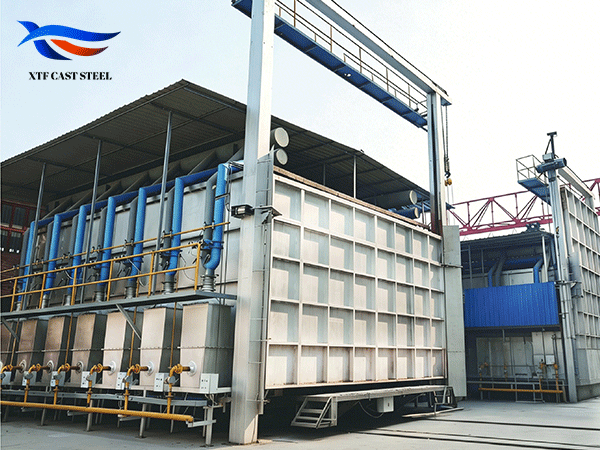
Heat treatment: look at the records, not a "job done" word
Heat treatment must match the material and the required performance; not every roller goes through the same cycle. For a typical grade like ZG42CrMo, a proven route is post-casting normalizing plus tempering in place of annealing, followed by a final normalizing and tempering—heating at 870–890 ℃, tempering at 630 ℃, surface hardness 205 HBW or above, and mechanical properties meeting JB/T 6402.
When inquiring and accepting, pin these down:
·Which heat-treatment process, and what technical requirements go with it
·The hardness range, where to measure it and by what method—after finish machining, a Leeb (portable) hardness tester is better than a hammer-type tester, so you don't leave dents on the surface
·Whether the strength, toughness and other indices on the drawing are met
·Whether the heat-treatment and test records for that batch are provided
Don't nod to "the harder the better." The roller works together with the riding ring, so material properties and hardness must be considered together; chasing one single index can backfire.
Machining quality: check item by item against the drawings
The working surface and the assembly locations must meet the dimensions, tolerances and surface quality on the drawings. At acceptance, go through the working-surface dimensions and profile, the bore or journal fit dimensions, and roundness, cylindricity, runout and surface roughness one by one. A smooth appearance does not replace actual measurement. The supplier must hand over the inspection records, so you can tell whether the roller will match the existing shaft, bearings and riding ring properly.
Inspection: put the standard and grade in writing
Writing only "passed inspection" or "Class 1 inspection" in the contract invites disputes later. The right way is to be specific: which method, which standard and revision, which areas, at which stage, and to what acceptance grade.
For a roller of this kind, ultrasonic testing is commonly carried out to JB/T 5000.14, Heavy Mechanical General Technical Conditions—NDT of Steel Castings, at Class Ⅲ; alternatively it can be agreed under standards such as GB/T 7233. Ultrasonic and magnetic-particle methods should be selected according to the material, structure and technical agreement—you can't simply substitute one for the other. The delivered documents must also correspond to the product number and batch, so material, heat-treatment and test results are traceable.
Replacing a roller? Check the whole kiln, not just the part
Whether a roller performs well is not only about itself. Worn riding ring, shifted support position, foundation settlement and poor installation adjustment all affect contact and load distribution. So before replacement, inspect the related components together with the old part's wear; install and adjust according to the equipment manufacturer's requirements and the on-site measurements.
Whether to use hydraulic lifting or laser measurement is a matter for the specific maintenance plan. Don't apply a single "1 mm allowed deviation" to every kiln, and don't assume that using some particular measuring tool will automatically extend service life.

When comparing prices, lay the scope of supply on the table
When comparing roller quotations, don't just look at the total price. Check these together:
| Items to Verify | Details to Clarify |
| Supply Scope | Roller body only, or complete assembly including shaft, bearings and other accessories |
| Material & Process | Material grade (e.g. ZG42CrMo), manufacturing method and heat treatment specs |
| Machining Requirements | Drawing revision, key dimensions, tolerances and fitting requirements |
| Inspection Requirements | Test methods, standards (e.g. JB/T 5000.14), inspected zones and acceptance grade |
| Delivery Documents | Material certificate, heat treatment report, NDT and dimensional inspection records |
| Delivery Arrangement | Manufacturing lead time, packaging and transportation requirements |
In a word, choosing a roller means weighing the material, manufacturing, inspection and whether it fits your equipment all together. When the technical agreement is clear and the documents are traceable, you can compare proposals, accept the product and plan maintenance with confidence.
At Xintengfei we do the casting and finish machining of support rollers in-house, covering grades such as ZG42CrMo, ZG310-570 and ZG35CrMo, and have long served customers like CITIC Heavy Industries and Jiangsu Pengfei. If you want to discuss a support roller plan, send us the drawings, quantity, material requirements and delivery location; for replacement parts, attaching wear photos of the old roller makes the technical discussion and the quotation much easier.


Henan Xintengfei Steel Casting Co., Ltd.
Henan Xintengfei International Import & Export Trading Co., Ltd.
Henan Gongxing Casting Materials Co., Ltd.
Henan Xintengfei Heavy Industry Technology Co., Ltd.
Henan Zhongshi Xintengfei Shipbuilding Heavy Industry Co., Ltd.
No.1 Qianjin Avenue, Mengzhuang Town, Huixian City, Henan Province, China


