Internal Porosity vs Shrinkage Cavity & Shrinkage Porosity in Steel Castings: Distinguish Material Selection, Process Control and Service Life Differences Once and for All
Many purchasing personnel from foundries have encountered frustrating issues: costly steel castings develop cracks and leakage within half a year after installation, or even right after the running-in period, forcing costly equipment shutdowns and maintenance. Most people tend to attribute failures to harsh working conditions, yet a vast majority of premature malfunctions stem not from external loads, but internal casting defects. Hidden flaws formed during casting — internal porosity and shrinkage cavity/shrinkage porosity — are the real invisible culprits.
This article conducts an in-depth comparison from 5 core dimensions: root causes, morphological features, inspection methods, impacts on service life, and source prevention solutions adopted by qualified manufacturers. It will help you fully differentiate porosity from shrinkage defects and avoid procurement pitfalls.
Basic Definition of Two Defects (First Clarify the Concepts)
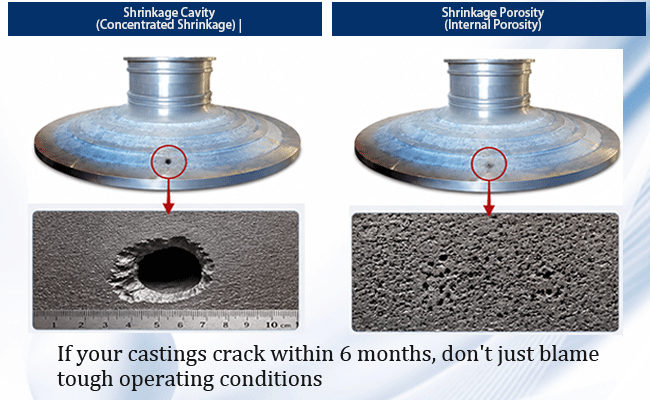
1. Internal Porosity (also called Microshrinkage / Dispersed Shrinkage Porosity)
It resembles a sponge, referring to insufficient densification of the internal microstructure of steel castings. The fundamental cause is inadequate refining of molten steel, incomplete deoxidation and degassing. Excessive inclusions and dissolved gas trapped in molten steel fail to escape fully during solidification, forming scattered tiny cavities or non-dense micro-regions inside the casting. As technical data specifies, poor deoxidation in molten steel refining, excessive impurities and low compactness are the leading triggers of internal porosity.
2. Shrinkage Cavity & Concentrated Shrinkage Porosity
It is equivalent to a large hollow cavity or cave. The root cause lies in unreasonable casting process design, especially insufficient feeding capacity of the gating system. Volume contraction occurs when molten steel solidifies in the mold cavity; if the riser cannot supply sufficient liquid steel to compensate for such shrinkage, concentrated irregular cavities will form at heavy sections or hot spots of castings. This aligns with the technical conclusion that defective feeding and gating design leave shrinkage cavities and porosity during solidification.
Item-by-Item Comparative Analysis
1. Structural & Metallurgical Comparison
Microscopically, internal porosity presents as countless scattered pinholes or sponge-like porous structures distributed throughout the casting. Macroscopically, shrinkage cavities are one or multiple large, irregular concentrated voids, mainly concentrated at hot spots such as maximum wall thickness and corner transitions.
In short: Porosity is an inherent material quality problem; shrinkage cavity is a fatal structural hard defect.
2. Mechanical Performance Comparison
Internal porosity can be analogized to a leaky pipeline: the overall structural outline remains intact, but loose internal microstructure drastically reduces overall strength and fatigue resistance. A shrinkage cavity is like a large hole rupturing the pipeline: it directly breaks structural continuity, triggers severe stress concentration at defect locations and easily initiates cracking. The two defects exert vastly different impacts on mechanical properties.
3. Operational Performance Comparison
Castings with internal porosity may operate normally in the initial running stage. However, under alternating stress over long-term operation, porous areas gradually expand, causing abnormal micro-vibration and increased noise. Locations with shrinkage cavities carry extremely high stress concentration factors, which generate obvious abnormal noise and vibration from the early operation phase, acting as direct fracture initiation sources with far greater hazards.
4. Applicable Working Condition Comparison
Internal porosity is highly sensitive to service conditions. It may barely function under low-stress and non-critical positions, but its service life will drop sharply under heavy impact, heavy load and alternating stress working conditions, such as large gear rings and crusher crossbeams. Shrinkage cavities are fatal defects. Any components subjected to tensile, bending or impact loads (e.g., mill housing, bearing chock, hollow shaft) are strictly prohibited from use if containing shrinkage cavities.
5. Maintenance Cost & Service Lifespan Comparison
Internal porosity is a chronic defect: it shortens service life significantly, raises maintenance expenses, and leads to pitting corrosion and fatigue cracks that eventually result in fracture. Shrinkage cavity is an acute catastrophic defect, likely causing sudden component breakage, complete equipment scrappage, massive production suspension losses and safety accidents. In terms of severity, shrinkage cavities are far more dangerous than dispersed internal porosity.
Similarities & Core Differences Summary (Key Takeaways for Clients)
Common Points
Both are internal hidden defects invisible to naked eyes, which can only be detected via Non-Destructive Testing (NDT) including UT (Ultrasonic Testing), MT (Magnetic Particle Testing) and RT (Radiographic Testing).
Both drastically downgrade fatigue strength, toughness and tightness of steel castings, leading to shorter-than-expected service life.
Both originate from flawed process control by foundries, closely related to raw material quality, gating system layout and heat treatment specifications.
FAQ Section
Q1: Can internal porosity and shrinkage cavities be identified visually?
Hardly ever. Both are hidden internal discontinuities requiring professional NDT equipment for detection. This explains why it is critical to demand third-party flaw detection reports from suppliers during procurement.
Q2: As a buyer, how to judge whether a steel foundry can eliminate such defects?
Equipment Configuration: Equipped with LF refining furnace, large heat treatment furnaces, complete testing instruments (direct reading spectrometer, UT/MT flaw detectors, etc.);
Process Capability: Adopts CAE casting simulation to optimize gating and feeding systems, implements double aging heat treatment process;
Qualifications & Track Records: Possesses ISO 9001 certification and mature service cases for heavy industry clients in mining, cement, hydraulic engineering sectors.
Q3: Which defect imposes greater negative impacts on equipment service life?
Shrinkage cavity is more harmful. It triggers severe stress concentration and sudden brittle fracture. Internal porosity only gradually weakens fatigue performance and causes premature failure.
Q4: Is the cost high to rectify these casting defects?
The cost of prevention is far lower than rework and remedy. Defect avoidance via optimized processes, premium raw materials and strict in-process inspection is cost-controllable during production. In contrast, defective delivered castings will trigger equipment downtime, repair work or even total scrappage, generating comprehensive losses dozens or hundreds of times higher than the product value itself.